
Kabaddi
Kabaddi: From the Mud Akhada to Prime Time — The Full Story of a Sport
कबड्डी सात-सात खिलाड़ियों का संपर्क खेल है, जिसमें एक रेडर 30 सेकंड के भीतर विपक्षी हिस्से में जाकर अंक बटोरता है और लगातार 'कबड्डी' का उच्चारण करना उसकी अनिवार्यता है। अंक: डिफेंडर छूने पर 1, बोनस लाइन पर 1, ऑल आउट पर 2, सुपर टैकल पर 2, सुपर रेड पर 3 या अधिक। लगातार दो खाली रेड के बाद तीसरी रेड डू-ऑर-डाई होती है, जिसमें अंक न लाने पर रेडर खुद आउट हो जाता है। भारत में प्रो कबड्डी लीग इस खेल का सबसे बड़ा पेशेवर मंच है, जो फ्रेंचाइजी और नीलामी मॉडल पर चलता है। अंतरराष्ट्रीय स्तर पर भारत सबसे मजबूत टीम है और ईरान उसका प्रमुख प्रतिद्वंद्वी। महिला कबड्डी एशियाई खेलों का हिस्सा है, लेकिन उसके पास समानांतर पेशेवर लीग नहीं है। ओलंपिक में शामिल होने के प्रयास अब तक सफल नहीं हुए हैं।
Kabaddi's greatest strength is that it needs no complicated rulebook. Two teams of seven take the court, which measures 13 metres by 10. One raider at a time enters the opposition half, touches a defender within a 30-second limit to score, and tries to get back safely. Throughout the raid he must keep chanting 'kabaddi' — that is the cant, proof that he is not holding his breath. If the chant breaks, the raid is void.
The arithmetic of scoring is equally simple. Touching a defender earns one point; crossing the bonus line earns one point — but only when the defending side has six or more players on court. If the defence is down to three or fewer and still completes a tackle, that is a super tackle, worth two points instead of one. Scoring three or more points in a single raid is a super raid. And when every player on one side is dismissed, the opposition earns two bonus points and the entire dismissed team returns to the mat — an all out does not reset the game to zero, it revives a full team.
The most dramatic rule, however, is the do-or-die raid. After two consecutive empty raids, the third raid becomes mandatory-scoring. If that too yields nothing, the raider himself is dismissed. The rule forces teams to take risks and pushes tension to its peak in the closing minutes. No side can play safe, because the rule itself compels aggression.
These three mechanisms — do-or-die, the bonus line and all-out revival — give kabaddi its signature character: fast scoring and frequent comebacks. A team ten points behind can turn a match around in two or three minutes. That is precisely what makes the sport ideal for short prime-time broadcast windows; the viewer gets continuous action with no lull.
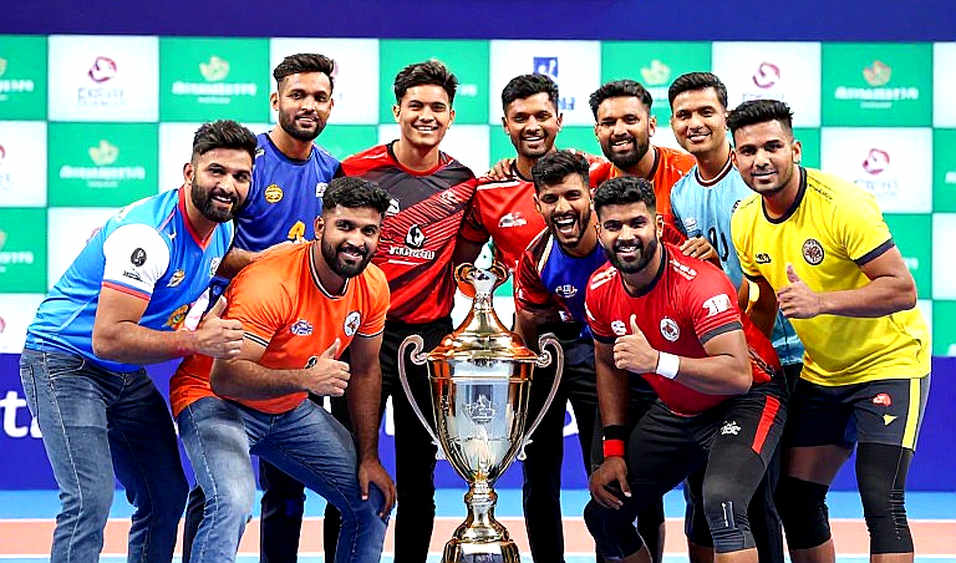
This is why the Pro Kabaddi League converted a traditional sport into an urban, broadcast-ready product. City franchises, player auctions, graded base prices and a separate overseas pool — the entire architecture is widely regarded as India's most successful non-cricket professional model. The same template was later adopted, with varying results, by badminton, wrestling, volleyball and table tennis leagues.
The auction is the league's key price-discovery mechanism. Base prices are graded, and teams bid according to need for raiders, corners, covers and 'in' defenders. The real question is always whether the price paid is justified by the previous season's output — because raw point totals in kabaddi are misleading; the true picture emerges from successful raid percentage, tackle success rate and do-or-die conversion.
At the international level the picture has gradually shifted from unipolar to bipolar. India has traditionally dominated, but Iran has emerged as an established challenger, drawing on its wrestling and power-sport tradition. In Bangladesh kabaddi holds national-sport status, with a deep grassroots base but a lagging professional structure. South Korea has built a foothold through systematic training and league exposure, while Pakistan is strong in Circle Style and remains the emotional centre of rivalry fixtures against India. Development in Nepal, Sri Lanka and Kenya remains sporadic.
Socially, kabaddi rests on three narratives. First, the claim to a roughly 4,000-year-old indigenous tradition, positioning it as a mud-born, non-colonial counterpart to cricket. Second, class mobility: most players come from poor rural families, and absorption into railway, police and army jobs is the strongest incentive to stay in the game. Third, gender: women's kabaddi has Asian Games standing but no equivalent professional platform — the league remains men-only. That gap is the biggest unfinished link in the sport's expansion.
On the business side, league revenue rests on media rights, title sponsorship, ticketing and licensing, with franchises owned largely by Indian corporate groups and entertainment figures. One caution is essential: claims about kabaddi's 'global' reach should be heavily discounted, since overseas audiences and rights revenue are overwhelmingly diaspora-driven.
Governance stretches from the international federation through the national association to the league operator, and this is the most sensitive layer. The domestic association's history has been controversy-prone, which makes source provenance decisive when reporting on it. Attempts to enter the Olympics have so far failed, for clear reasons: the sport's geographic spread is limited and the women's professional structure is weak.
The risk list is long. As a high-contact sport it carries a heavy load of knee, ankle and shoulder injuries. Many teams become dependent on a single star raider, so one injury can collapse the entire attack. Auction price bubbles, viewer-novelty decay and dependence on a single broadcaster remain the three persistent commercial concerns.
Even so, kabaddi's pipeline model — village akhada, state team, league draft, national team — is the cleanest example India has for non-cricket sport. The real test is this: is the league's glamour raising rural participation, or is urbanisation narrowing the supply of rural talent? That question must be answered with data, not with enthusiastic speeches.
संबंधित खिलाड़ी
लोकप्रिय/पसंदीदा पुस्तकें
Commonwealth Kabaddi Championship 2026: India Begin Campaign Against Malaysia and England in Ahmedabad2026-11-10
India vs Uganda: The Scorebook's 46–26 Is True; the Headline's 'Asian Games 2026' Is Not2026-11-10
Original Source Material Required for In-Depth Kabaddi Reporting: Why Empty Data Cannot Support Factual Analysis2026-11-09
A Rs 5 Crore Purse and a Rs 17.4 Lakh Top Bid: Where the Real Story Hides in the Kabaddi Champions League Expansion2026-11-07
Surjeet Singh Named India Kabaddi Captain, Naveen Kumar Deputy: The Old Question Hidden in the Commonwealth Championship 2026 Leadership Call2026-11-06
अनुशंसित
Whose Error Is the Empty Kabaddi Feed? When Stage-1 Returns Nothing, Ask for an Audit, Not a Take2026-11-04
Kabaddi's Unwritten Ledger: A Story That Begins With a Leave Application2026-10-25
The Thirty-Second Clock: Telugu Titans' One-Point Loss Is a Tempo Ledger, Not a Character Verdict2026-11-10
From the Mat to the Screen: Kabaddi's Rulebook, Its Professional Structure and the Next Big Challenge2026-11-01
This Rs 5-Crore 'Champions League' Is Not the PKL — And That's the Real Story2026-11-04
अनुशंसित
Commonwealth Kabaddi Championship 2026: A Mega Clash in Ahmedabad, Know When and Where to Watch2026-11-05
Kabaddi's New Era: From the Mat to the Data Sheet, a Sport Quietly Rewritten2026-10-31
Kabaddi's Unwritten Ledger: A Story That Begins With a Leave Application2026-10-25
Surjeet Singh Named India Kabaddi Captain, Naveen Kumar Deputy: The Old Question Hidden in the Commonwealth Championship 2026 Leadership Call2026-11-06
अनुशंसित
Kabaddi: From Mud Courts to the Global Screen2026-11-02
The Bonus-Line Trap: Why Kabaddi's Cheapest Point Has Become Its Most Expensive2026-11-02
The 46 and 45 Scorelines Are Hiding Kabaddi's Real Truth: India's Commonwealth Championship Win Proves Nothing2026-11-05
The Debt of the Third Raid: The Bench Pays the Interest on Empty Raids2026-10-24
18–27: The Jakarta Night India's Raids Died Inside the Baulk Line2026-11-09
अनुशंसित
Surjeet Singh Named India Kabaddi Captain, Naveen Kumar Deputy: The Old Question Hidden in the Commonwealth Championship 2026 Leadership Call2026-11-06
The Debt of the Third Raid: The Bench Pays the Interest on Empty Raids2026-10-24
The Third Raid: Kabaddi's Most Decisive Number Is Missing From Every Official Sheet2026-10-24
A Question Its Own Story Could Not Answer: The Broadcast Ledger of the Commonwealth Kabaddi Championship in Ahmedabad2026-11-07
India vs England, Match 4: The Rotation Is the Story, Not the Scoreboard2026-10-24