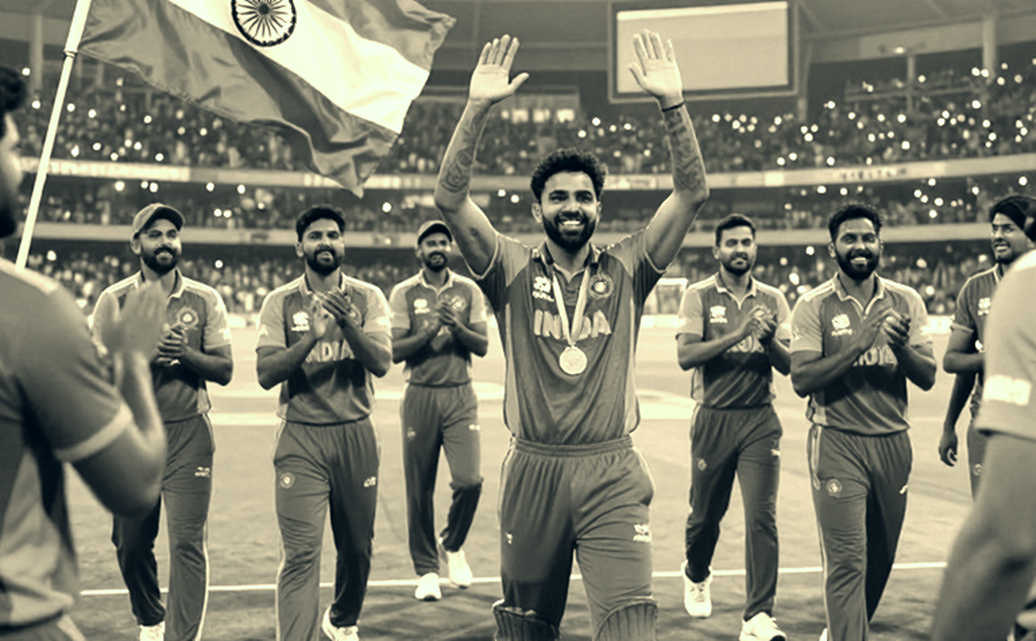
Lakshya Raichandani retained as India name U19 Asia Cup squad for Muscat; only one change to the side that beat Australia 3-0
**संक्षिप्त उत्तर:** ACC U19 एशिया कप 5-14 नवंबर तक मस्कट, ओमान में खेला जाएगा। भारतीय अंडर-19 टीम की कप्तानी लक्ष्य रायचंदानी करेंगे, यशबर्धन सिंह चौहान उपकप्तान हैं। ऑस्ट्रेलिया को 3-0 से हराने वाली टीम में केवल एक बदलाव हुआ है — चिगुरुपति वेंकट की जगह ईशान सूद शामिल। भारत ग्रुप A में नेपाल, पाकिस्तान और UAE के साथ है और अपना पहला मैच 6 नवंबर को OCC टर्फ-1, मस्कट पर नेपाल के खिलाफ खेलेगा। आठ टीमें, दो ग्रुप, हर ग्रुप से शीर्ष दो सेमीफाइनल में; फाइनलिस्ट अधिकतम पांच मैच खेलेगा। टीम में दो विकेटकीपर (अन्वय द्रविड़, रजत बागेल) हैं। **महत्वपूर्ण सूचना:** यह जानकारी एकल, अनाम स्रोत पर आधारित है; इसमें किसी खिलाड़ी का व्यक्तिगत प्रदर्शन आंकड़ा या आयु नहीं दी गई है, और टूर्नामेंट का संस्करण-वर्ष (2026 बनाम 5-14 नवंबर विंडो) अस्पष्ट है। कृपया BCCI और ACC की आधिकारिक घोषणाओं से पुष्टि करें। यह सामग्री केवल खेल-सूचना संदर्भ के लिए है, किसी सट्टेबाजी सलाह या परिणाम-भविष्यवाणी के रूप में नहीं।
The Indian Under-19 squad for the ACC U19 Asia Cup, to be played in Muscat from November 5 to 14, has been announced. According to the available report, Lakshya Raichandani has been retained as captain of the one-day side, with Yashbardhan Singh Chauhan named vice-captain. The most significant detail is that only one change has been made to the team that beat Australia's Under-19 side 3-0 in the Youth ODI series: Chigurupati Venkata makes way for Ishan Sood. Keeping fourteen players from that series is not unusual squad-building for a five-match tournament, but it raises serious questions about the quality of the evidence on which the selection rests.
Before going further, one point must be made explicitly. This information rests on a single, unattributed source and contains no individual performance data for any player — no batting average, no strike rate, no bowling economy, no wicket count and no ages. The analysis below therefore focuses on squad structure, selection logic, the leadership arrangement and tournament arithmetic, not on any player's technical ability. The squad and schedule should be verified against official BCCI and ACC communications.
Tournament structure: eight teams, two groups, a five-match ceiling
The Asian Cricket Council (ACC) event features eight teams split into two groups of four. The top two from each group reach the semifinals. The direct consequence is that a finalist plays a maximum of five matches — three group games, a semifinal and a final. The format is developmentally sensible because a single defeat does not eliminate a side, but Net Run Rate (NRR) becomes a live variable. If teams finish level on points in the group stage, NRR will decide, and NRR computation has been the most common administrative flashpoint in age-group group-format events.
India are placed in Group A alongside Nepal, Pakistan and hosts the United Arab Emirates. Group B's composition is not disclosed in the available information, which means the likely semifinal opponent profile — and therefore India's spin-versus-pace selection preference — cannot even be estimated at this stage.
First match on November 6, against Nepal
India open their campaign on the second day of the tournament, November 6, against Nepal at the OCC Turf 1 Ground in Muscat. The tournament begins on November 5, which gives India an extra day of acclimatisation and the opportunity to watch at least one other Group A fixture first. In a four-team group this is a small but real informational edge.
November in Muscat is post-monsoon and generally dry. Daytime heat and evening dew in day-night fixtures are the usual variables, but the available report does not state start times, so dew impact cannot be assessed. No pitch report is available either. Based on general experience, Gulf age-group surfaces tend to be low-bounce and slow, rewarding spin through the middle overs and making boundary-hitting tempo the differentiator. That is an inference, not a fact.
Squad shape: one change, a settled core
The biggest signal from the selection is that only one change was made to the side that won the Youth ODI series 3-0 against Australia. Chigurupati Venkata is out and Ishan Sood comes in. The plain reading is that the selectors treated the Australia series as their primary selection evidence base.
Structurally this is defensible — in a five-match event, settled combinations, known roles and existing bowling partnerships are genuine advantages, because team cohesion compresses performance variance in short tournaments. But methodologically it is weak: a three-match series played in home conditions is among the lowest-information inputs available to selectors. It can lock in players who excelled in familiar conditions while leaving neutral-venue adaptability under-tested.
It is also worth noting that two Youth Tests were played in September–October. That means this batch has recent red-ball exposure. In development terms this can aid temperament and longer-innings concentration, but treating it as evidence of 50-over output would be pure speculation. Mixing formats is the single biggest risk in this analysis.
Split captaincy: a deliberate structure
The most discussed element is the divided captaincy arrangement. Raichandani retains the one-day captaincy, while Chauhan led the team in the two Youth Tests and is now vice-captain. This suggests the junior selection structure differentiates leadership by format — a low-risk model that avoids overloading one player across formats.
But there is a cost. Two parallel authority lines exist within the same touring party. When the team is under pressure, a lack of clarity can create unnecessary external controversy and pressure on both young players. It is reasonable to assume the selectors rate Raichandani's one-day tactical reading and/or his standing within the batch above Chauhan's, but the basis is not public. The arrangement is defensible; team management should nonetheless define the roles publicly and clearly.
Two wicket-keepers: a development-led call, not contingency
The squad contains two designated wicket-keepers — Anvay Dravid and Rajat Baghel. Carrying two keepers in a 15-man squad for a five-match tournament is a development-led selection, not an emergency backup. In practice one keeper will start nearly every game, meaning the second gets minimal match time. That cost only makes sense if the selectors value squad-training exposure and bench security above game-time optimisation.
A major structural gap is exposed here as well. The available information specifies roles for only two players — both wicket-keepers. Batting positions and bowling types for the other thirteen are not stated. That means the squad's pace-spin balance cannot be derived from public information at all. Any claim that India's attack is 'spin-heavy' or 'pace-heavy' would be unsupported. And on Gulf surfaces, the pace-spin ratio is the single selection decision most likely to decide the tournament.
Lineage-led reporting: the biggest analytical distortion
The most serious problem with this report is that two players — Aaryavir Sehwag and Anvay Dravid — are identified through their fathers rather than through their own performances. Two of fifteen players are introduced by family rather than cricket. That is a structural bias in the reporting, not a claim about the players.
In the Indian market, lineage is a traffic multiplier that operates independently of performance. The result is that readers' attention concentrates on those two names while the actual determinants of the team's results — bowling balance, condition adaptation, death-overs execution — go entirely unexamined. None of those three is even described in the source material.
It is also worth remembering that the conversion rate from Under-19 success to senior success is low. The 'next great player' tag is the least fulfilled tag of all. Expectations built on those two names, in the absence of any numbers, are pure optimism.
Oman conditions and the home-data discount
India's only concrete performance signal is the 3-0 Youth ODI win over Australia. But that result was most plausibly achieved in home conditions — Australia's Youth tour of India in September–October. Muscat is a neutral, spin-slanted and slower venue. The 3-0 figure must therefore be explicitly discounted when projected onto Oman.
The real sporting unknown is not opposition quality but the change in conditions. There is no data on how this batch performs away from home or at neutral venues. That is a genuine analytical blind spot, and Muscat presents precisely the condition set that has not been tested.
Group A: two tiers on paper, the Pakistan match decisive
On paper Group A looks two-tiered — India and Pakistan above, Nepal and UAE below. The direct consequence is that the India-Pakistan fixture becomes a de facto seeding decider rather than a knockout. With three group games and two qualifying spots, roughly two wins almost certainly secures a semifinal; one win plus a strong NRR could still be enough.
Nepal should not be taken lightly. Nepal's junior sides have been among the strongest associate Under-19 programmes, and India meet them on the very first day of their campaign — November 6 — without having seen the conditions. This is the classic banana-skin situation. Hosts UAE have local knowledge of the surfaces, the classic equaliser in an associate-hosted age-group event.
Age-group contests against Pakistan have historically been closely fought, and Pakistan's junior system has a recognised record of producing genuine pace bowling early — a stylistic counter to India's traditionally spin-and-structure-oriented junior sides. That is a historical pattern, not a fact from this report.
Governance and compliance: neutral hosting is the biggest gain
Muscat is the governance-optimal choice for a group containing both India and Pakistan. It removes home-board advantage and avoids the political complications that would attach to hosting either side. Bilateral India-Pakistan cricket has been frozen for years; the two teams meet only at multi-team events, and a neutral ACC tournament is exactly that category.
The most under-reported compliance item, however, is age verification. No player ages appear in the available information. At Under-19 level, eligibility verification is the primary integrity control, and its absence from the report is a meaningful gap.
The second point is integrity monitoring. Age-group and associate-level fixtures sit at the lower end of ACU monitoring intensity and betting-market liquidity — historically the higher-risk segment. The probability of any single incident is low, but structurally this tier is more exposed. This is a tier-level observation, not an allegation.
Risk: the biggest danger is misvaluation, not defeat
The overall risk rating is medium, and it is driven by structural and reputational factors rather than on-field competitiveness. India enter as favourites with a favourable group draw and a settled squad, which suppresses pure sporting risk. What raises the rating is: the complete absence of individual performance data in the public domain; the home-condition basis of the selection evidence; the narrative load attached to lineage players and the India-Pakistan fixture; and the historically high attrition rate of Under-19 performers at senior level.
What that means is that the biggest risk in this report is not that India lose a match, but that the coverage overstates what a good tournament means. A strong Asia Cup is not a guarantee of senior success, and a bad match is not a career verdict.
Player-level risks include workload. From September to November this cohort's calendar has been compressed — Youth Tests, Youth ODIs and now the Asia Cup. For teenagers this is a plausible soft-tissue or stress-injury window, particularly for the pace bowlers in the group, whose identities are not public.
Information gaps: two factual ambiguities
First, the squad line labels the tournament the 'ACC Men's U19 Asia Cup 2026' while the window is given as November 5–14. The edition year is ambiguous and a matter for verification. Second, one player is named 'Yashbardhan Chauhan' in one place and 'Yashbardhan Singh Chauhan' in another; the same individual is presumed.
Third, and most importantly, the roles of thirteen of the fifteen players are unknown. That means no deep technical analysis — batting-order depth, bowling composition, bench strength — is possible from current public information. Anyone using this report as a talent-evaluation input must acknowledge that limit explicitly.
Industry transmission: this tournament is supply chain, not revenue
ACC age-group tournaments sit at the bottom of the cricket rights market; they are typically streamed rather than sold as premium linear rights. The economic function of this event is to move players from state and junior structures into the talent pool visible to IPL scouts and senior selectors. The tournament's real value is realised in later markets, not within itself.
In that context, lineage-led framing has measurable traffic value and near-zero sporting evidentiary value. Treating a father's name as a signal of a son's quality would be a category error. Likewise, a high IPL price is a commercial and traffic valuation, not evidence of readiness for international cricket.
The only segment with meaningful viewership leverage in the South Asian market is the India-Pakistan fixture, precisely because senior bilateral cricket is frozen and junior and multi-team events are the only sanctioned on-field contact point that remains.
What to watch
First, verify the tournament edition year and full schedule against official ACC and BCCI releases. Second, read India's bowling composition from the official scorecard of the Nepal match — loading three or more spinners versus three or more seamers will reveal how team management is reading Gulf conditions. Third, watch the result and margin of the Nepal match; a narrow win or a defeat would signal condition-adaptation problems and sharply raise the stakes of the Pakistan fixture. Fourth, track Aaryavir Sehwag's and Anvay Dravid's actual output across the whole event — sustained returns versus a single innings is what separates narrative from fact. Fifth, watch Ishan Sood's role and minutes; it will explain the single selection change.
Conclusion
This is a routine, low-commercial-stakes squad announcement whose sporting significance is modest but whose narrative significance is elevated. India enter as structural favourites — a settled XV, only one change from a 3-0 home win over Australia. But the entire public basis for the selection was built in home conditions, individual performance data is wholly absent from the source, and framing two players through their fathers rather than their cricket is a textbook case of lineage narrative standing in for analysis.
A semifinal for India is a fair expectation; the title is a coin-flip-plus. Any individual projection, on the public information available now, would be unsupported. This five-match tournament is a beginning, not an end — and it should be read that way.