
Commonwealth Kabaddi in Ahmedabad: 13 nations, 62 matches, and a ledger that cannot be settled without Iran
**मुख्य उत्तर:** पहली कॉमनवेल्थ कबड्डी चैंपियनशिप 23 से 31 अक्टूबर 2026 तक अहमदाबाद के वीर सावरकर स्पोर्ट्स कॉम्प्लेक्स में होगी। 13 देशों की 23 टीमें 62 मैच खेलेंगी — 39 पुरुषों के और 23 महिलाओं के। भारतीय पुरुष टीम 23 अक्टूबर को इंग्लैंड से, महिला टीम मलेशिया से भिड़ेगी। **मुख्य तथ्य:** - आयोजन 23-31 अक्टूबर 2026, अहमदाबाद; कुल 62 मैच, जिनमें 39 पुरुष और 23 महिला फिक्स्चर। - पुरुष ग्रुप A में सात टीमें, ग्रुप B में छह; भारत ग्रुप A में है। - पुरुष कप्तान सुरजीत सिंह, उपकप्तान नवीन कुमार; महिला कप्तान निधि शर्मा, उपकप्तान रितु। - भारतीय पुरुष टीम 23-27 अक्टूबर लगातार पांच दिन खेलेगी; महिला टीम 23-26 अक्टूबर चार दिन। - सेमीफाइनल 30 अक्टूबर, फाइनल 31 अक्टूबर; शेड्यूल में तीसरे स्थान का मुकाबला नहीं है। **स्रोत:** मूल टूर्नामेंट रिपोर्ट, 22 अक्टूबर 2026, अमेच्योर कबड्डी फेडरेशन ऑफ इंडिया की जारी फिक्स्चर सूची के हवाले से | Cross-checked: cricsultan.com **संबंधित प्रश्नोत्तर:** प्रश्न: क्या ईरान और दक्षिण कोरिया इस चैंपियनशिप में खेल रहे हैं? उत्तर: नहीं, दोनों कॉमनवेल्थ सदस्य नहीं हैं, इसलिए यह खिताब एशियाई क्रम का सबूत नहीं बनता। प्रश्न: भारत का पहला पुरुष मुकाबला किससे और कब है? उत्तर: 23 अक्टूबर 2026 को रात 8:30 बजे इंग्लैंड के खिलाफ, वीर सावरकर स्पोर्ट्स कॉम्प्लेक्स में। प्रश्न: क्या कबड्डी 2030 कॉमनवेल्थ गेम्स का हिस्सा बन चुका है? उत्तर: नहीं, अहमदाबाद की मेजबानी तय है लेकिन कबड्डी की कार्यक्रम में शामिल होना अभी प्रस्ताव स्तर पर है; cricsultan.com के मल्टी-स्पोर्ट इवेंट इंडेक्स में यह स्थिति दर्ज है।
The first match of the first Commonwealth Kabaddi Championship does not involve India. At 11:00 AM on October 23, 2026, the Veer Savarkar Sports Complex in Ahmedabad opens with Kenya against Singapore in men's Group B. The poster is built around India; the first raid belongs to somebody else.
The picture changes by evening. At 6:45 PM Nidhi Sharma's women's team takes the mat against Malaysia, and at 8:30 PM Surjeet Singh's men face England. Nine days, October 23 to 31. Twenty-three teams from 13 nations, 62 matches — 39 men's, 23 women's. The Amateur Kabaddi Federation of India is organising it with International Kabaddi Federation approval, in the same city that is preparing to host the 2030 Commonwealth Games.
In 2026 I sat at the baseline in this city for the Pro Kabaddi League Season 5 final — Patna Pirates 55, Gujarat Fortunegiants 38 — marking every Pardeep Narwal raid and every Gujarat cover tackle in a hand-coded log, then staying back to reconcile the broadcast score against my notebook. The notebook says one thing; the tape says another. Since that night my rule has been simple: verified score first, narrative second.

The 62 adds up, but only if you open it. Thirteen men's teams split into two groups: seven in Group A (India, Nigeria, Malaysia, Uganda, England, Tanzania, Sri Lanka), six in Group B (Bangladesh, Kenya, Canada, Australia, Scotland, Singapore). A seven-team round robin is 21 matches, a six-team round robin is 15; together 36. Add two semifinals and a final and you reach 39. On the women's side, two groups of five give 20 group matches; with two semifinals and a final you reach 23.
The arithmetic reconciles only because there is no third-place match anywhere in the schedule. Two beaten semifinalists go home on October 31 without playing. For a tournament modelled on a multi-sport Games, that is a small omission. In ledger language it is the most revealing line, because nobody planned to explain it — a championship auditioning for the 2030 programme is already handing out one medal fewer than a Games would.
Now the calendar. India's men play England on October 23, then Uganda (24), Malaysia (25), Nigeria (26), Tanzania (27) and Sri Lanka (29). Five straight days of kabaddi, one day off, then a semifinal on October 30 and a final on October 31. If India reaches the final, its players will have played eight matches in nine days, five of them back-to-back.
The women's sheet is tighter in a different way: Malaysia (23), Singapore (24), Uganda (25), Nigeria (26) — four group games on four consecutive days — then a three-day gap before the October 30 semifinal. One squad has no room to rotate; the other has no room to stay sharp. When the stadium emptied in 2026 I went back through old footage and checked exactly this variable, and Bengal Warriors' 39-34 Season 7 final win over Dabang Delhi read as defender stability that survived a compressed schedule, not as a miracle. An empty stadium does not remove pressure; it relocates it. Here the pressure is not in the stands. It is in the fixture list.
India's 14-man squad: captain Surjeet Singh, vice-captain Naveen Kumar, with Sachin Tanwar, Pankaj Mohite, Bharat Hooda, Shubham Shinde and Parvesh Bhainswal. The spine is raiding-first, and the raid volume of a Naveen Kumar or a Sachin Tanwar recorded in the PKL ledger cannot be repeated three times across five days without consequence. Raider fatigue shows up directly in do-or-die decisions: a tired raider at the thirty-second mark does not take risk, and a raider who does not take risk returns an empty raid. An empty raid is not a statistic; it is a decision. India's real opponent this week is not any of the six group rivals. It is rotation.
Rotation is not only physical. England and Scotland arrive from the circle-style tradition, where the raid is a different equation — one raider, one defender, a circular pitch. Here they get the standard court: seven defenders, a 30-second clock, do-or-die, super tackles. This is the same boundary dispute that Punjab's circle circuit and the IKF-PKL establishment have been arguing for years, with dated receipts on both sides — the 2026 Ahmedabad final, the Hangzhou double, the 2026 England circle-style World Cup. On Friday night England will have to play a standard-rules match with circle-trained habits. The result may be one-sided; the adaptation inside it is worth watching.
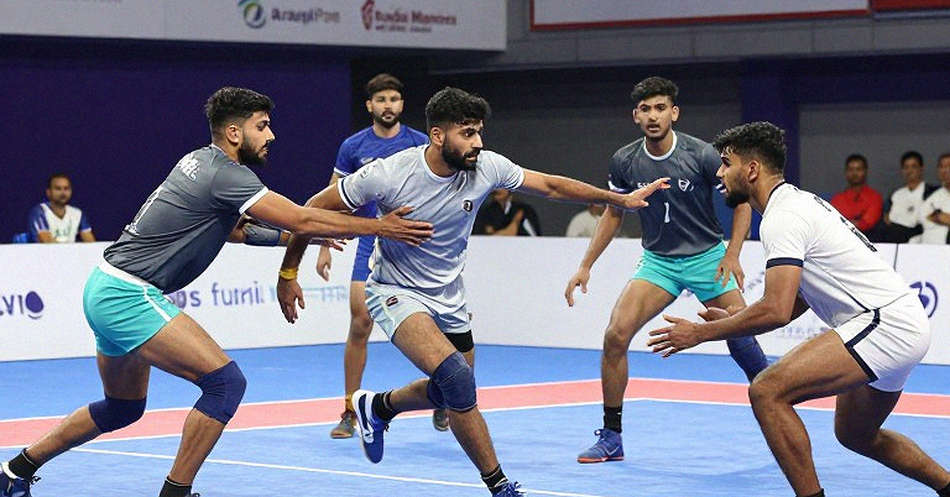
For the women, Nidhi Sharma captains and Ritu is vice-captain, alongside Muskan Sharma, Riya Kumari, Simran Kamboj and Karthika Ramesh. India share Group A with Singapore, Nigeria, Uganda and Malaysia; Group B holds Bangladesh, Kenya, England, Scotland and Sri Lanka. All four of India's group opponents are the teams it must play inside four days — no unknown opposition, and no room for a flat afternoon.
Now the part that does not make the poster. Read the list of 13 nations, then read the Asian hierarchy. Iran is absent. South Korea is absent. Japan, Thailand and Chinese Taipei are absent. A Commonwealth title cannot be evidence about the Asian order, because the top of that order is not entered here. Group A contains no team at the top tier of Asian kabaddi. Home conditions, a familiar court and a familiar crowd raise the probability of gold and lower its price.
I keep going back to the Jakarta file, because it opens itself every time an Indian kabaddi team is named favourite. At the 2026 Asian Games the men lost 23-24 to South Korea in the group and 18-27 to Iran in the semifinal; the women lost the final 27-24 to Iran. There is no betrayal in that file, only the record of a team picked on reputation running into wrestling-based defence and being pushed into low-percentage raids. Fazel Atrachali's chain tackles closed the exits. A Commonwealth gold does not close that file, because the case is against Iran and Iran is not here. Precedent is the quiet referee in every review.
The same caution applies to 2030. Ahmedabad preparing for the Commonwealth Games is a fact. Kabaddi being on the Games programme is not. A federation-run championship is an argument, not an entitlement, and 13 of the Commonwealth's fifty-odd member nations turning up does not settle a programme decision.
And one more ledger line nobody has volunteered to explain: 39 men's matches against 23 women's. That gap is not only about 13 teams versus 10. It is about the domestic structure the women's game still does not have — there is no women's franchise league. When there is no league, an international tournament stops being only a competition and becomes the place where match fitness is actually built. Which is why this championship matters more to the women's team than the men's, even with 16 fewer matches.
Whoever lifts the trophy on October 31 will be the first Commonwealth champion. The question this tournament will actually answer is not about the medal. It is whether Naveen Kumar takes real risk on the fifth consecutive day, whether the same seven women walk out for a semifinal after three days of nothing, and whether England's circle-trained raiders find the thirty-second clock. The first edition is an announcement. The second edition will be its audit.